
Hybrid training
One app for running and lifting
If you lift three times a week and run twice, you are probably keeping two records that never speak to each other. TotalBodyIQ reads both as one weekly load, because your body does.
Who wrote this
We make TotalBodyIQ. We are a small team in the UK, and this page argues for our app. Where another app is the better answer, we have said so, and any competitor figure is taken from that company’s own published pricing on the date shown.
The two-app problem
The strength apps are strength apps. The running apps are running apps. So a hybrid week ends up split down the middle: your squats in one place, your Tuesday intervals in another, and no single view of how much work you actually did.
That matters more than it sounds, because the split hides exactly the thing you need to see. A hard leg session on Monday and a hilly 10k on Wednesday both tax the same tissue. Neither app knows about the other, so both keep telling you that you are fresh. The week you feel inexplicably flat is usually the week the two halves of your training collided and nothing was counting.
One weekly picture
TotalBodyIQ tracks GPS runs, walks and rides with five heart-rate zones derived from your estimated max, and counts them toward the same weekly load model as your lifting. Not as a separate tab with its own charts, but as part of the same picture.
Your readiness knows about both
The daily 0–100 readiness score is built from recent training load and rest days, all of it, not just the barbell half. A heavy running week reads as a heavy week.
Sessions that get out of the way
When readiness is low, the generated session shortens instead of pretending nothing happened. When a muscle group is undertrained, it leans into it. The day after a long run, that is usually upper body.
No wearable, no subscription stack
Zones come from your estimated max and the phone in your pocket. Everything else is derived from the sets you log. There is nothing to buy, charge or strap on.
And it shows its working
Tap any score for a plain-English breakdown of what fed it, including which of your runs moved it, and by how much.
Three lifts, two runs, one readiness score
A real week, Monday 27 to Friday 31 July, straight out of the app. Upper Push, Lower Squat and Lower Posterior. A 7.40 km run on Thursday at 5:22 a kilometre and a 4.40 km run on Monday at 4:53. A 45-minute ride and an hour of padel on top. All of it in one feed, and all of it feeding one number.
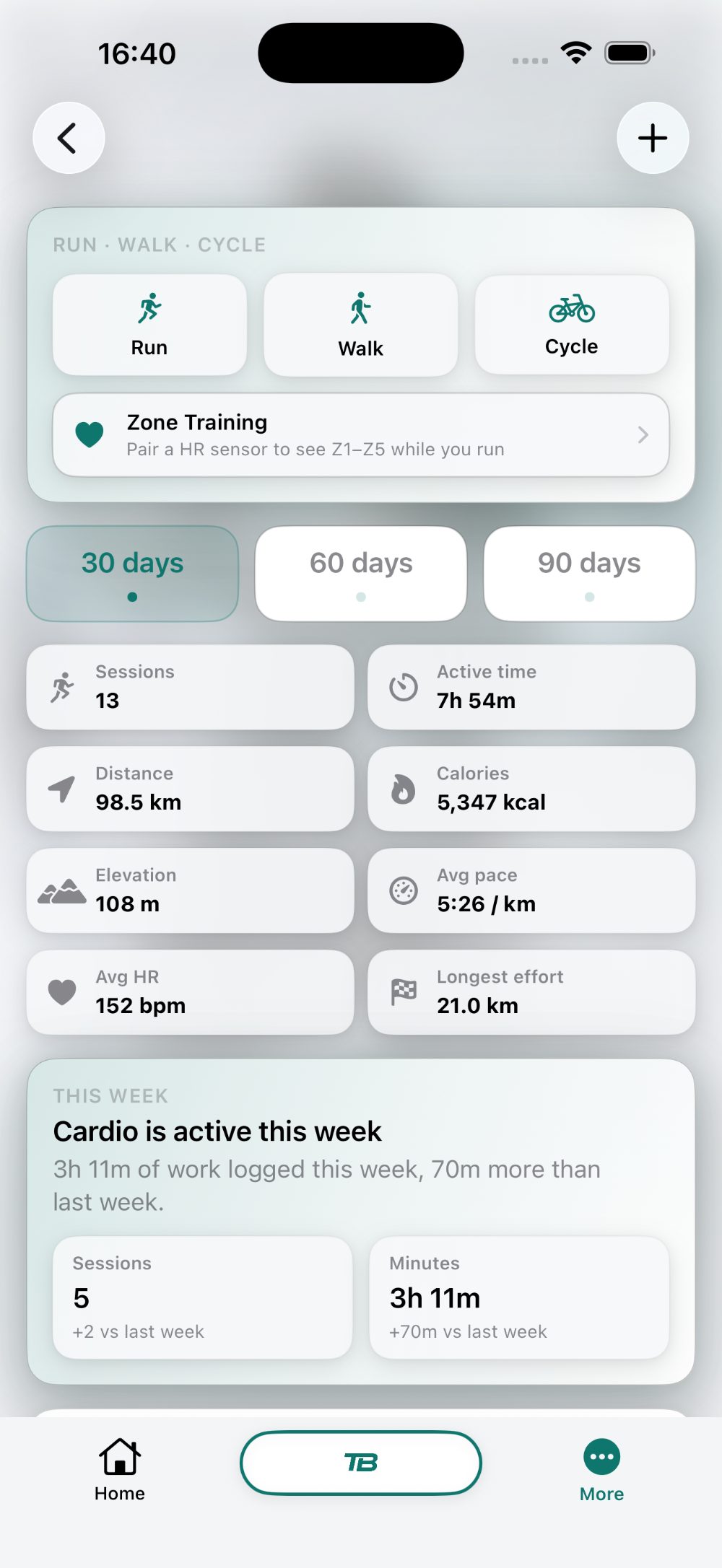
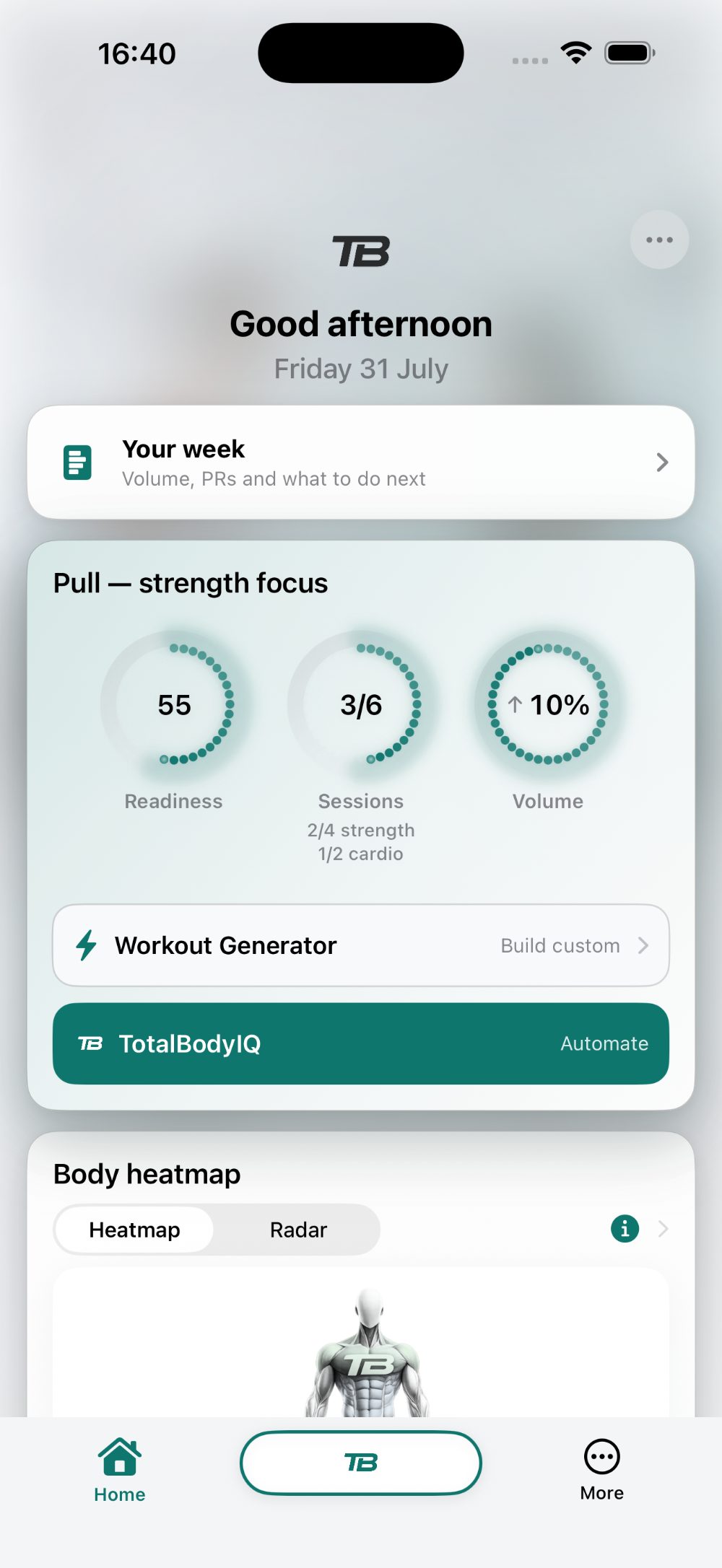
Note the line under Sessions: 2/4 strength, 1/2 cardio. Both halves of the week are tracked against their own target, and both move the same readiness score. That is the whole difference from running two apps.
What the alternatives are good at
If running is your main sport and lifting is accessory work, Strava is the better home for your training and it is not close. Route planning, segments, the social side, years of race-day analysis. None of that is what we do. Strava keeps a free tier that covers GPS tracking, and its paid subscription is £8.99 a month or £54.99 a year. What it will not do is tell you which muscle groups your lifting is neglecting.
If lifting is the whole point and you barely run, a dedicated strength app is a fair pick: Hevy for logging, Fitbod for generated sessions. Both are more established than we are. Both are lifting only.
Strava UK pricing checked 31 July 2026; Strava prices are standardised per country, so confirm yours in-app. Fitbod and Hevy pricing checked the same day on their own published pages.
TotalBodyIQ is built by a small team in the UK. Email support@totalbodyiq.co.uk and it reaches the people who build the app, usually answered within 24 hours.
If what you need is right for the app, it gets built.
Stay on two apps if…
- You are training for a specific race and need proper endurance periodisation. We are not a running coach and will not pretend to be.
- Segments, routes and the Strava social feed are a real part of why you run.
- You already own a watch whose recovery metrics you trust and act on.
- You are on Android. We are iPhone only for now.
But if you just want the honest answer to “how much have I actually done this week, and what should I do tomorrow”, that question needs both halves in the same place, and that is the app we built.
Lifting and cardio, one weekly load.
GPS and cardio tracking are in the free tier. No wearable, no expiry.
Download on the App StoreMore comparisons